

This is final part of a three-part in-depth analysis of the public education funding formula in Virginia. (Find Part 1 and Part 2 here)
SOQ Reform in Virginia: Where Do We Go From Here?
This is Part 3 in a three-part series providing an in-depth analysis of the public education funding formula in Virginia. Part 1 examined the conceptual weaknesses and analytical limitations of JLARC’s 2023 K–12 study. Part 2 presented a “true cost” model rooted in actual spending and actual local revenue capacity. Part 3 asks the key question: so what? What do these findings mean for policymakers, for local governments, and—most importantly—for Virginia’s children?
The central finding: Virginia is not necessarily underfunding education—but the SOQ formula is
Across Virginia, school divisions collectively spend close to $19 billion (state and local funding) to educate 1.25 million students. This amount—roughly 15,000 dollars per student–reflects what it truly costs schools to provide Virginia’s kids with a quality public education in the real world. Yet the state’s official Standards of Quality (SOQ) formula claims that a “quality” education costs billions of dollars less than that. Local governments therefore contribute more than $6.6 billion above their required SOQ obligation just to keep schools operating at contemporary standards.
The mismatch between the state’s funding standards and the actual spending levels—more so than the actual aggregate level of funding—is the heart of the problem. A formula that understates needs will always misallocate resources, distort local responsibilities, and mask underlying inequities. Reform must thus begin by recognizing the simple truth that the current SOQ framework is disconnected from reality.
With the General Assembly having effectively abdicated its role in setting appropriate education funding standards, the funding burden of education has been disproportionately shifted on local governments. As far as the vertical allocation of resources, while the state likes to believe that it contributes 55 percent to public education needs in the state, in reality, the state’s contribution is only around 40 percent. In practice, local governments bear the brunt of the fiscal burden for public education in Virginia.
Yet the burden of local public education funding is not distributed equally across the Commonwealth. With respect to the horizontal allocation of resources, the maps and simulations presented in Parts 1 and 2 reveal a consistent pattern, most notably that the high-cost, high-wage, high-demand school divisions in Northern Virginia, parts of Central Virginia, Hampton Roads are systematically underfunded by the SOQ formula. By contrast, many lower-cost, lower-need rural divisions receive state allocations that come much closer to their spending needs. The SOQ formula’s underestimation of public education needs also depresses local funding obligations, allowing some localities to contribute far less than their actual ability to pay. These are not isolated anomalies. They are the product of deliberate policy choices and structural political incentives within the SOQ framework.
What Virginians expect from their schools (and their General Assembly)
One of the most important, yet least discussed, issues is that Virginia’s SOQ norms no longer reflect what communities expect from their schools. The SOQ standards were originally intended to define a statewide standard of educational quality. Over time, however, the standards have become disconnected from community expectations and actual funding practices. Across the board, local governments in the Commonwealth fund schools at levels significantly higher than the SOQ baseline.
In essence, the General Assembly has abdicated its constitutional role in setting meaningful Standards of Quality for public education in Virginia. As a result of an ongoing political tug of war—with some legislators focused on tax cuts without regard for education quality, and other legislators focused on spending more without regard for efficiency and equity— Virginia’s public education funding system has evolved into a de factosystem of locally-driven educational standards, while the de jurestate-defined standard has become outdated and irrelevant.
As an agency of the General Assembly, JLARC may not have been in a position to critically assess the shortcomings of the current SOQ formula or the role that state-level political economy forces have played in shaping the current formula. As a consequence, however its policy recommendations are based on a sugar-coated assessment of public education funding in Virginia that ignores the fact that the SOQ formula is no longer operationally relevant. Its recommendation is to reform the current SOQ norms by gradually increasing state-level funding without meaningfully acknowledging—or addressing—the fundamental vertical and horizontal misalignments (until at least a decade from now). As such, JLARC’s proposals merely add additional layers of spending to the existing formula without confronting its fundamental weaknesses, resulting in increased state spending on public education while downplaying or ignoring the inequitable distribution of state and local contributions—especially those affecting Northern Virginia and other high-cost areas.
A modernized framework: Principles for a realistic 21st-century SOQ formula
Virginia needs to reframe the debate. The central question is not: “Does Virginia spend enough on public education?” but rather “Is Virginia allocating education resources in a way that is objective, efficient, equitable, and aligned with real needs?” The preceding analysis (in Parts 1 and 2) makes clear that the answer to this question is negative. Instead, a modern education finance system for Virginia should:
- Recognize the actual cost of educating Virginia’s students – rather than continuing to tolerate SOQ cost norms that remain disconnected from actual spending,
- Ensure that every locality contributes to its public schools what it can, not what it chooses,
- Compensate school divisions fairly for the real cost of living in their localities,
- Replace arbitrary and outdated norms with transparent financial standards, and
- Deliver a consistent quality of education across the Commonwealth—without relying on hidden subsidies, inequitable burdens, or political inertia.
Reforming Virginia’s education finance system is not merely a budgeting exercise. It is a governance choice about fairness, transparency, and the Commonwealth’s long-term economic and social future. It is clear that Virginia needs an updated Standards of Quality funding framework grounded in principles of equity, transparency, and alignment with real-world conditions, in order to regain meaningful state leadership over public education funding.
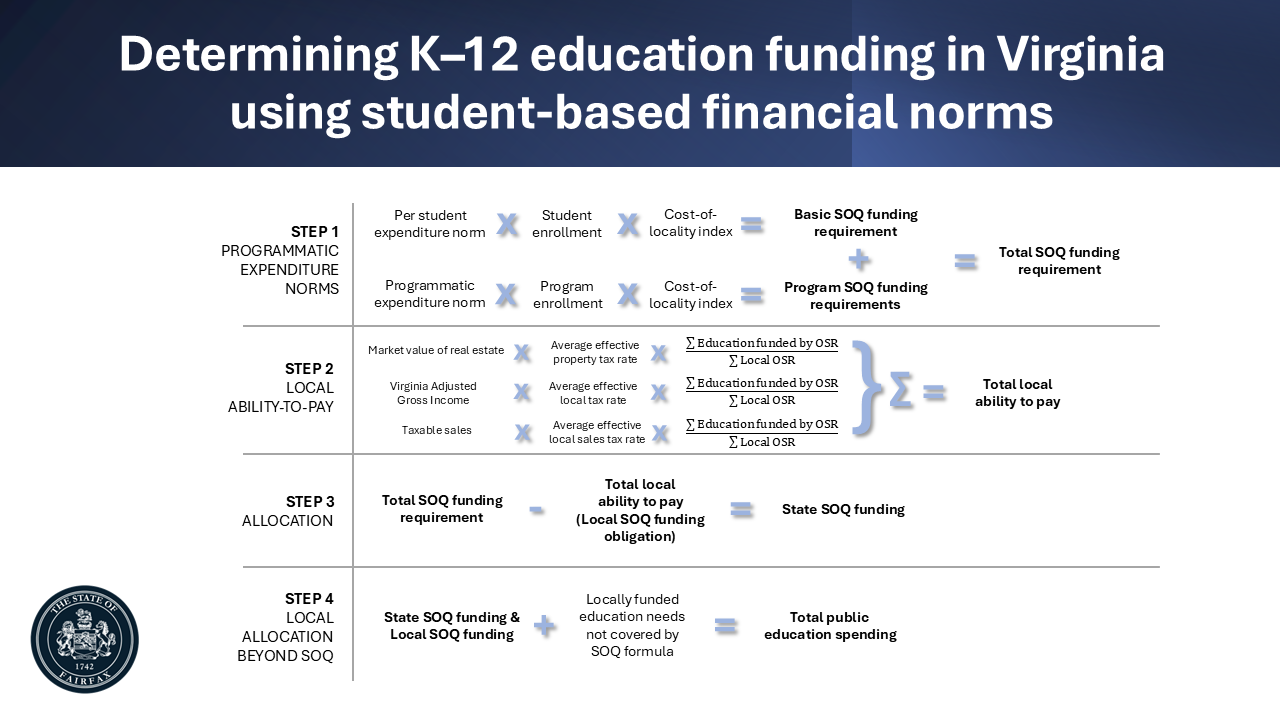
1. Establish public education needs based on real costs—not theoretical staffing ratios. The current SOQ formula—and JLARCs recommendations—envision SOQ standards that are based on politicized service delivery norms and cost assumptions to the point that the funding formula itself is practically irrelevant. Shifting to financial norms based on actual statewide average spending (minus federal aid) as the baseline for determining the Standards of Quality will ensure that the formula reflects the actual funding requirements being faced by a modern school system, while ensuring its affordability when state and local governments work together.
2. Adjust for programmatic differences across localities. Different parts of the commonwealth have different levels of need when it comes to public education. Special education, English learners, and at-risk students impose real, measurable costs. A modern SOQ formula should incorporate program-specific financial norms grounded in audited expenditure data—not politically negotiated multipliers.
3. Integrate an objective, transparent cost-of-living index. Likewise, a cost-of-living adjustment is not a bonus to be negotiated down to the lowest politically acceptable standard—ensuring cost-adjustments as part of the SOQ formula ensures equal educational opportunity across regions with vastly different wage and housing markets. Without it, teacher salaries in Northern Virginia will remain uncompetitive in real terms, and Northern Virginia taxpayers will continue to pay a local property tax premium so that local officials in other parts of the Commonwealth can promise tax cuts to their constituents—with teachers and students ultimately paying the price.
4. Anchor local obligations in objective revenue capacity. An objective Representative Revenue System—based on actual tax bases and average effective tax rates—ensures that each locality contributes according to its true ability to pay, not according to a composite index that is subsequently applied to inadequate and outdated SOQ funding standards.
5. Create greater local fiscal space for responsive local leadership. There is no such thing as a perfect grant formula. Even with an optimal formula, some local governments will face a higher demand for local public education. These local governments ought to have access to a range a broad-based revenue instruments to effectively fund public education in a way that meets the standards demanded by their local community. A local-options income tax–similar to the one in Maryland–should be considered in Virginia.
Before proceeding, it bears repeating a caveat made previously: there is no such thing as a perfect formula, or a perfectly objective formula. For technical insiders, the basic analysis presented here already points to a number of ways in which the alternative formula could be improved or fine-tuned to both be technically more responsive and to be more politically acceptable. Despite its own potential shortcomings, however, the alternative formula presented here does convey a critical reality: the current proposals for public education funding reform being discussed by state leaders are wholly inadequate.
How would state SOQ funding be distributed differently using an SOQ approach based on true costs and actual ability-to-pay?
Introducing an alternative SOQ formula that is based on true costs and actual ability-to-pay would fundamentally alter the vertical and horizontal allocation of public education resources, aligning it with actual public education spending requirements in the Commonwealth, based on the existing size of the public education funding pool, and the actual relative contributions of the state and local government levels. Doing so would combine the results of the “true cost” (program-specific and cost-of-living adjusted) financial norms with the actual local ability-to-pay for each local government in Virginia. The “true cost, actual ability-to-pay” funding formula would set the state SOQ grant as the difference between the expenditure requirement of each school division and its local ability-to-pay. By construct, the grant would be affordable, as the total (state plus local) SOQ obligation is defined based on actual state plus local funding levels.
Unsurprisingly, given the earlier analysis, state grants using a “true cost, actual ability-to-pay” funding formula would generally shift grant resources from the lower cost-of-living parts of the state and the localities that currently under-contribute to their own public education needs to the higher cost-of-living parts of the state. (However, as noted further below, the analysis reveals some surprising outliers). Whereas the alternative SOQ formula results in a technically superior (more efficient and equitable) allocation of state public education resources, the maps below reveal an incidence pattern that suggests that the introduction of the new formula would be politically problematic (or potentially, downright impossible).
Whereas a positive difference between the alternative grant and the actual grant means that a locality is currently underfunded, and a negative difference means that a locality is currently overfunded, politicians tend to see the proposed change in allocations as “winners and losers”. In particular, rather than being grateful that they received too much funding in the past, jurisdictions that are currently overfunded would consider themselves “losers” under the alternative formula—and would almost certainly oppose any reform of the funding formula that does not benefit them. Given the current politically-driven imbalance in public education funding in Virginia, correcting for this imbalance would create for more “losers” than “winners”. Welcome to reality: adopting an efficient and equitable funding formula is not a technical challenge that can be fixed by technical experts, it is a political economy challenge instead.
Full map: State SOQ grant based on true cost and local ability-to-pay (per student)
Full map: Difference between True Cost State SOQ grant and Actual SOQ grant (per student)
Given that the current SOQ approach systematically underfunds higher-cost local governments, it should come as no surprise that the alternative “true cost and actual ability-to-pay” SOQ formula generally favors higher-cost local governments in the Commonwealth. As a region, the table below suggests that the current formula short-changes the Northern Virginia region by roughly 800 million dollars per year. The analysis suggests that Fairfax, Loudoun, and Prince William Counties have an annual funding shortfall of 432 million dollars, 221 million dollars, and 214 million dollars, respectively.
Given this funding shortfall, it is unsurprising that Fairfax County Public Schools is looking for additional funding each year. Yet, based on these results, rather than creating a conflict with the Board of Supervisors, it might behoove FCPS and the County Board of Supervisors to team up and make their point more vocally, and in an evidence-informed manner with the public, and directed towards the County’s delegation in Richmond.
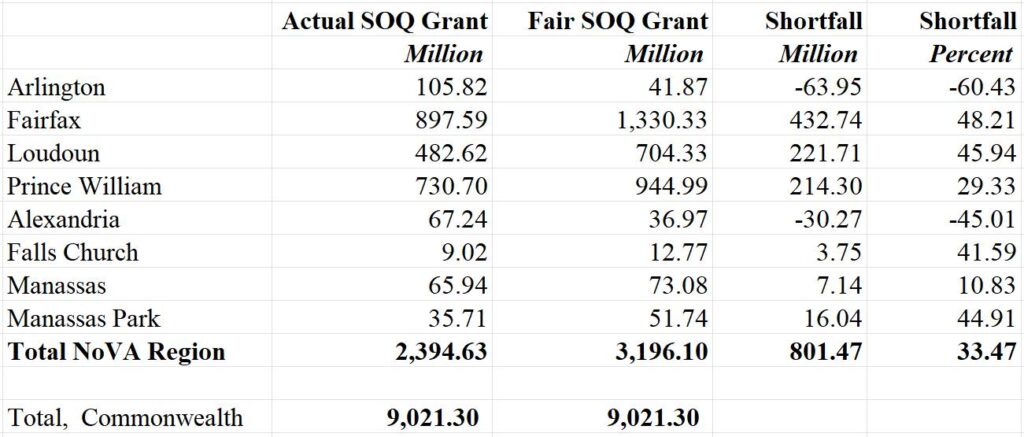
Although the alternative “true cost and actual ability-to-pay” formula generally favors higher-cost local governments, a more detailed look at the results for Northern Virginia suggests some surprising outliers. For instance, whereas Arlington was noted earlier in the analysis as being underfunded in terms of cost-of-living adjustments, resetting the ability-to-pay bar based on actual spending norms would result in Arlington (and Alexandria) actually receiving less in state SOQ funding under the alternative formula than under the current SOQ grant formula.
How to move forward from here?
The analysis of public education funding in the Commonwealth suggests a political reality in which meaningful reforms require the General Assembly and state leaders to confront the implicit bargains that have led to a SOQ formula that is fundamentally flawed. Any proposal for a technically-sound funding formula will collide with deeply embedded political dynamics:
- Most localities benefit from the current underestimation of SOQ costs, because it gives them more grant funding than they deserve, and keeps their official local SOQ obligation artificially low.
- High-cost regions bear a disproportionate share of the real burden, but represent a minority of the Commonwealth’s jurisdictions (and voting power in the General Assembly).
- Cost-of-living adjustments look like “special treatment” to some legislators, even when they simply equalize real purchasing power.
- Raising SOQ norms to real-world levels increases both state and local responsibilities. While reforms would create winners and losers on both sides, the losers will always be the loudest stakeholder in the room.
These tensions explain why Virginia’s public education funding system has remain stuck—and is likely to remain stuck—in a cycle of partial fixes. True reform will require recognizing that neither the existing formula, nor proposed incremental reforms—based on outdated norms, understated costs, and political compromises—is capable of delivering educational equity. If Virginia wants a school finance system worthy of its aspirations—and its constitutional commitments—it must modernize the SOQ formula from the ground up. This requires Virginia’s political leaders at all levels not just to go for cosmetic or “tax-and-spend” solutions, but to meet the challenge and fundamentally address the underlying issues that are at fault with the current SOQ approach.
State leadership. For Virginia’s new state leadership—including the Governor-elect and Lieutenant Governor-elect—this means more than pursuing the easy path of simply increasing state funding within the existing SOQ structure. Reform must begin with an honest assessment of the formula’s underlying inequities.
Given that Northern Virginia accounted for about 88% of their victory margin in the recent election, it will be essential for the new administration to recognize that true education finance reform cannot come at the expense of Northern Virginia’s taxpayers. A reform agenda that places even greater fiscal burdens on contributing jurisdictions—without correcting the existing imbalances—would only deepen regional inequities and erode public trust in state leadership.
The General Assembly (including the state delegates and state senators representing Fairfax and other Northern Virginia Counties). Although the General Assembly may argue that it is meeting the letter of the Virginia Constitution with the current SOQ funding formula, it is clearly failing to meet the spirit of its constitutional responsibility to provide for the cost of maintaining an educational program that meets a meaningful standard of quality.
Although the General Assembly may argue that it is fulfilling the letter of the Virginia Constitution through the current SOQ framework, it is failing to meet the spirit of its constitutional responsibility: to “provide for the cost of maintaining an educational program that meets a standard of quality.” Not a single local school division in Virginia is able to operate their public schools without contributing significant local funding beyond their local obligation. In fact, the policy norms applied by the state have been so degraded over time that in some cases, local governments spend twice the official norm.
The regional and fiscal imbalances in Virginia’s public education funding system do not align neatly with political or partisan divisions, making it more difficult to orchestrate a solution to the problem. Ironically, current political economy forces have Republican legislators supporting greater redistribution—benefiting their constituents—while Democratic leaders, particularly those representing higher-cost jurisdictions, are reluctant to oppose increased state spending on public education, even though those funds are directed to the wrong places.
For this reason, state delegates and senators representing Fairfax, Loudoun, and Prince William Counties—along with Stafford, Spotsylvania, Chesterfield, and several other high-cost jurisdictions—bear a particular responsibility to champion a more efficient and equitable system. Their constituents are effectively paying the price of the current policy misalignment, to the tune of approximately one billion dollars annually, for a funding mechanism that compels them to shoulder more than their fair share of public education expenditures while taxpayers in other regions contribute less than their capacity allows.
The first step toward this outcome is policy awareness. State delegates and senators must become fully informed about the magnitude of the problem and recognize that JLARC’s recommendations do not provide a viable or equitable path forward.
Virginia families, taxpayers, and educators. In a representative democracy, elected officials respond to the priorities voiced by their constituents. If those most affected by the inequities of the current system remain silent, reforms will not occur.
One of the challenges with the breakdown of the state’s public education funding mechanism—and whyVirginia families, taxpayers, and educators have largely stayed silent–is that the complexities and the technical nature of the funding formula have obfuscated the nature and size of the formula’s inequitable impact.
Yet, a more equitable and evidence-based funding formula would yield tangible benefits for residents of localities that are currently disadvantaged by the formula: for example, households in Fairfax County could save or redirect nearly $1,000 per year, allowing a major reduction in local property taxes, a major increase in local education funding (and higher teacher salaries), or a combination of both.
Therefore, Virginia families, taxpayers, and educators—particularly in high-cost and high-contributing localities—must inform themselves and make their concerns known. They should actively engage their state representatives to advocate for a fair and transparent recalibration of the SOQ formula.
Local civic organizations, homeowner associations, chambers of commerce, community coalitions, and nonpartisan advocacy groups all have an important role to play in raising awareness of the issue. These groups can help the public understand how the current SOQ framework negatively affects both the adequacy of local school funding and the household budgets of local taxpayers.
County leadership and education leaders. The Virginia Code authorizes counties to adopt measures that “secure and promote the health, safety, and general welfare of their inhabitants.” Promoting the general welfare must include ensuring that residents understand how the Commonwealth’s public education funding system constrains the local capacity to deliver essential public services.
For some local jurisdictions, the fiscal impact of the current, outdated SOQ formula is substantial—underfunding them by up to $1,000 per household each year—impacting the quality of public schools, creating upward pressure on local taxes, and reducing the resources available for other public services, with the potential to negatively impact long term property values and local economic development. County leaders have both the authority and the responsibility to communicate these realities to their residents.
Local education leaders share this responsibility. By not engaging with the root causes that drive annual funding shortfalls, they risk perpetuating a system that harms both students and teachers. School boards, superintendents, and teacher associations should work collaboratively with county officials and civic leaders to inform families and educators about the broader fiscal structures that underpin their school budgets.
Mobilizing at the local level is essential. Transparent dialogue between residents, educators, and local officials is required to create the political momentum necessary for statewide reform. Only when families and teachers understand that the current system results in higher property taxes and lower real teacher salaries, they are more likely to demand a fair and modern funding formula.
The Path Ahead
Reforming Virginia’s education finance system will not be easy. It requires confronting uncomfortable truths about how public resources are distributed—and about the political incentives that have allowed inequity to persist. But without such reform, the Commonwealth will continue to rely on a formula that is out of step with both economic reality and constitutional intent.
To move forward, Virginia must not only acknowledge the inadequacy of the existing SOQ framework, but also commit to developing an evidence-based formula that reflects the true cost of education and the true capacity of localities to contribute.
Doing so requires informing and elevating the debate with technical evidence; bringing together a unique coalition of reform advocates; and fostering political leadership—at both state and local levels—that prioritizes implementing at a sound long-term policy solution over short-term political wins. Only by confronting the challenges posed by Virginia’s economic and demographic realities can Virginia arrive at an efficient and equitable public education finance system that supports high-quality schools in every region of the Commonwealth.
Part 3 concludes this series.