

During the November 25, 2025 meeting of the Fairfax County Board of Supervisors Economic Initiatives Committee, economists from the Weldon Cooper Center for Public Service presented a detailed Revenues and Returns Analysis—a comprehensive assessment of how much Fairfax County contributes to the Commonwealth’s General Fund and how much it receives in return. The findings confirm what many Fairfax residents have sensed for years: Northern Virginia, and Fairfax County in particular, is the fiscal engine of Virginia—yet receives a disproportionately small share of state funding in return.
For those of us who have independently analyzed these patterns, the Weldon Cooper study is striking not because its conclusions are necessarily surprising. In fact, the study’s results align closely with back-of-the-envelope estimates we produced earlier. Instead, the results are striking because the analysis confirms that Fairfax County is a net donor locality on a massive scale—one that would be unusual anywhere, and one that is increasingly difficult to justify in a high-cost, fast-growing region. In fact, the negative net fiscal balance for Fairfax County revealed by the Weldon Cooper study is even worse than anticipated.
Fairfax County generates one-fifth of the state budget
According to the Weldon Cooper report, Fairfax County generated $5.77 billion in General Fund revenues in FY 2024—20.7% of all state General Fund revenue, more than the next three highest-contributing localities combined. Nearly $4.57 billion of that came from individual income taxes alone, reflecting the county’s large, highly skilled, and high-earning workforce.
As such, the report confirms a simple reality: Virginia’s revenue base is powered by Fairfax County. The county represents just 13% of the state’s population, yet generates more than one-fifth of the dollars that pay for statewide priorities—including schools, health care, public safety, higher education, and transportation across every region of the Commonwealth.
But Fairfax receives only “50 Cents on the Dollar” in return
Despite producing $5.77 billion in revenue, Fairfax County received only $2.93 billion in state spending in FY 2024—just 11.1% of statewide General Fund appropriations.
This amount reflects the total benefits that Fairfax residents receive from the state budget: both in terms of direct state services, as well as grants to Fairfax County, for instance, state aid for funding Fairfax County Public School. The shortfall is unsurprising, as county leaders have raised the underfunding of Fairfax schools and transportation infrastructure for years. (In fact, a recently-completed analysis of public education funding in Virginia suggests that Fairfax is currently being underfunded to the tune of 432 million dollars per year).
According to the Weldon Cooper report, Fairfax ranks 128th out of 133 localities in terms of return-on-contribution: for every $1.00 Fairfax sends to Richmond, only $0.50 comes back. For comparison, our own earlier estimates suggested a return-on-contribution in the range of 49 to 64 cents per dollar, with a mid-range estimate of 56 cents.
What this means for the average household
The table below makes the impact of these imbalances real by presenting the study’s results in per-household terms. The average Fairfax County household contributes $13,550 to the state budget each year (mainly through income taxes and sales taxes), while receiving $6,874 in state-funded benefits and services in return. This reflects a net loss of 6,676 dollars per households per year, or a return of only $50.73 per $100 contributed.
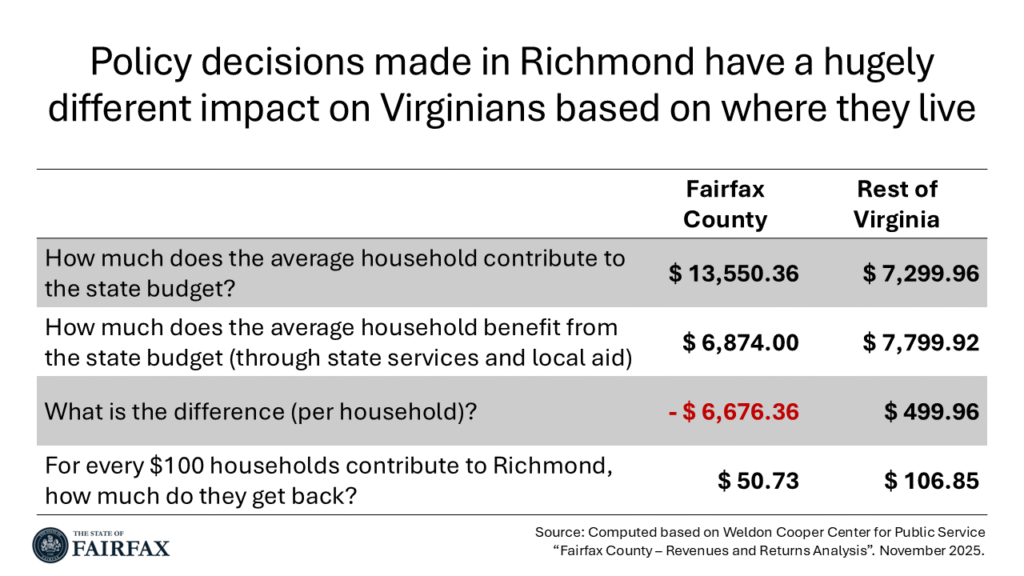
For households elsewhere in Virginia, the pattern is reversed. Excluding Fairfax County, the average contribution made to the state budget equals 7,300 dollars per household, while an average family benefits from state services and grants to the tune of $7,800 each year. The net gain is almost exactly 500 dollars per household, or a return of $106.85 per $100 contributed.
In other words, whereas families in the rest of Virginia generally “get what they pay for”, Fairfax families subsidize state spending for other regions at a scale unmatched anywhere in Virginia.
Why this matters
This imbalance is not simply an abstract fiscal issue—it affects daily life for Fairfax County residents. Because policy decisions made in Richmond fail to reflect both the county’s economic structure and its much higher cost of living:
- Fairfax County families get back less in terms of state services and local grant funding than families elsewhere in Virginia.
- Fairfax must rely heavily on local property taxes and other local revenues, which are higher than in most of Virginia.
- The county struggles to offer competitive salaries for teachers, police officers, firefighters, and other county workers.
- Residents increasingly perceive Richmond as extracting wealth without reinvesting proportionately, which erodes trust in state institutions.
- Most importantly, the imbalance limits the county’s economic potential, slowing growth in the region that fuels the Commonwealth’s prosperity.
The Weldon Cooper study provides the clearest evidence yet that Virginia’s current fiscal architecture is out of balance. The data are unmistakable: Fairfax County is the engine of Virginia’s economy—and yet receives a smaller return on its contribution than nearly any other locality. While fairness does not require equal dollars for every locality—but it does require state funding formulas that recognize cost of living, real revenue capacity, enrollment growth, and the evolving economic structure of regions like Northern Virginia.
As policymakers prepare for the 2026–28 budget cycle, this analysis should serve as a wake-up call. Virginia’s long-term fiscal health depends on ensuring that the regions that drive the Commonwealth’s prosperity are not held back by a structural imbalance that has grown too large to ignore.