
There is an old European joke about how the continent might be organized. In an ideal Europe, the British are the police, the Germans are the engineers, the French are the chefs, the Italians are the lovers, and the Swiss organize everything.
In Europe’s version of hell, the Germans are the police, the French are the engineers, the British are the chefs, the Swiss are the lovers—and the Italians organize everything. The humor, of course, comes from assigning the right jobs to the wrong countries.
Unfortunately, something very similar has happened with Virginia’s fiscal system. When it comes to how we fund different public services, we have assigned the right taxes to the wrong jobs.
What a well-designed fiscal system looks like
Public finance theory—and the practice of most well-designed fiscal systems—suggests a fairly straightforward logic.
State income taxes are generally the best way to fund redistributive public services, such as public education. Income taxes are progressive, linked to ability to pay, and able to support services that are intended to equalize opportunities across regions and households.
Sales taxes are typically used to finance broad statewide services and public investments that benefit everyone, such as transportation infrastructure or general state services.
Property taxes, by contrast, are most suitable for local public goods that benefit property owners and local residents directly—things like local roads, neighborhood infrastructure, and local services.
In other words, each tax works best when it is matched with the type of public service it is naturally suited to fund.
Virginia’s upside-down approach
Virginia’s system largely flips this logic on its head. In Virginia, local property taxes—especially real estate taxes—carry much of the burden for funding public education, even though education is arguably the Commonwealth’s most important statewide redistributive public service.
Meanwhile, sales taxes are partially dedicated to education and transportation, even though sales taxes are a relatively blunt instrument for funding redistributive services.
And state income taxes—our most progressive and redistributive tax instrument—primarily finances general state operations, rather than being the principal engine for funding K-12 education.
The result is a fiscal structure where the right revenue tools are assigned to the wrong policy objectives—much like the punchline of the European joke.
Why it matters
This mismatch has real consequences. When education is funded heavily through local property taxes, school funding becomes tied to the wealth of local jurisdictions, but also to the willingness of local communities to pay more for better education.
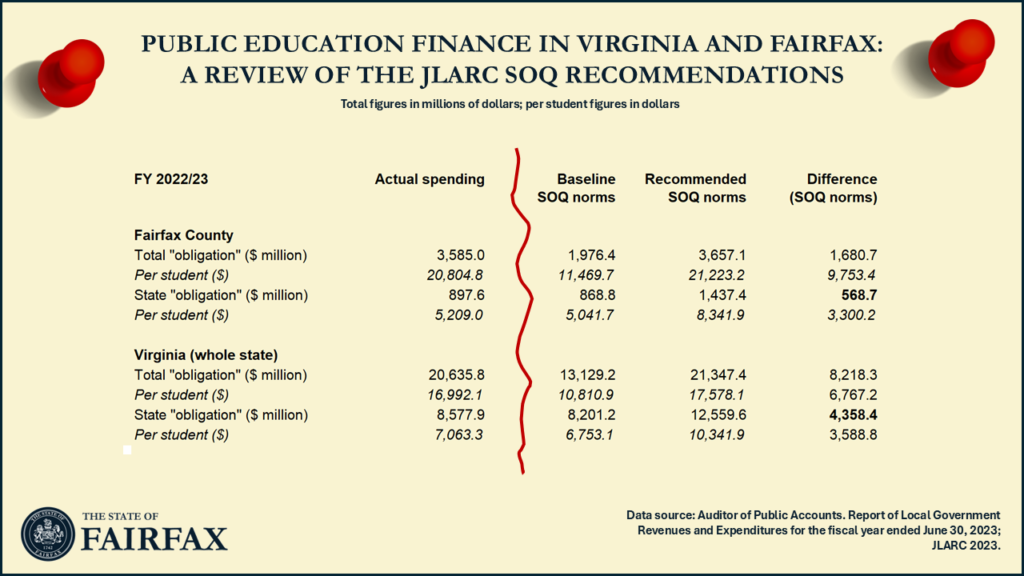
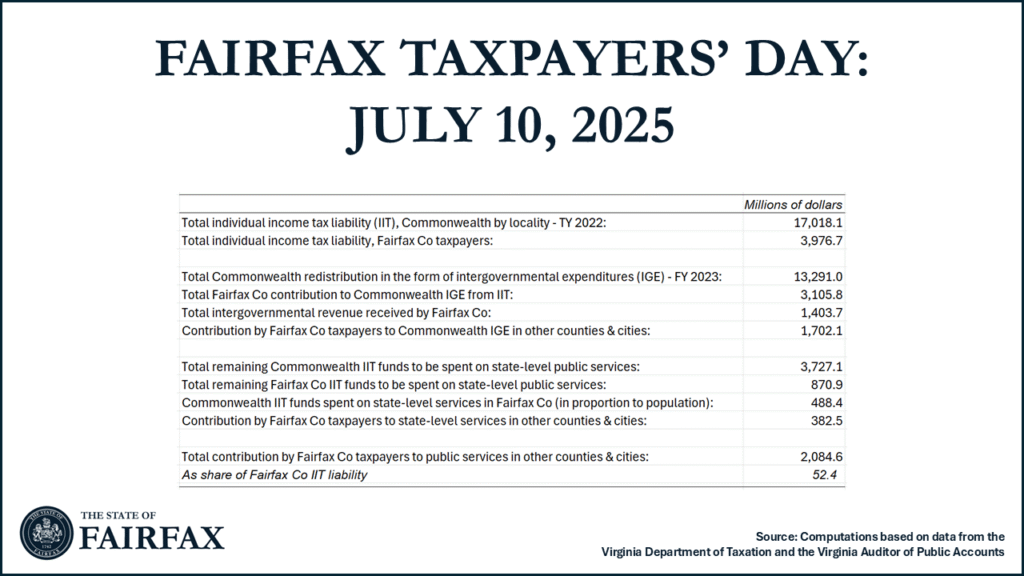
Because wealthier communities can raise far more revenue with the same tax rates, the state engages in considerable redistributive funding of local public education—with some localities receiving over two-thirds of education funding from the state, while others barely receive 15 percent. As an unintended consequence, however, pro-education localities that receive little grant funding have to raise property tax rates, while allowing low-willingness localities to lower theirs. The net result: wealthy taxpayers in low-education jurisdictions end up paying less in local taxes than poor households in high-education jurisdictions.
An additional distortion arises from the unusual way Virginia assigns responsibilities between the state and local governments. While local governments are expected to fund a large share of public education through local property taxes, in most of the Commonwealth local roads are funded and maintained by the state, not by local governments. This disconnect weakens fiscal accountability by allowing localities to keep property taxes low without fully bearing the consequences of underfunding public services—even if local communities don’t contribute through local taxes, the state will still fill the potholes and fund the teachers’ salaries.
At the same time, communities that value strong public services and well-funded schools bu tlack a strong property tax base often have to turn to less popular local revenue sources to close the gap. This has meant relying on politically unpopular taxes such as the local personal property taxes—including the widely disliked “car tax.”
Getting the assignments right
A more rational fiscal structure would align taxes and responsibilities more clearly.
In a more aligned fiscal assignment, state income taxes would play a larger role in funding public education across Virginia, ensuring that every child in Virginia has access to quality public education. In order to achieve this, however, the marginal tax rate might have to be increased — which is not political popular in parts of the state. If state funding for public education is increased, care should be taken not to punish taxpayers in wealthier, pro-education, and high-cost localities—as is currently the case—by giving back less than they deserve and thus requiring them to raise local property taxes instead.
Shifting more of the burden of education funding to the state would create fiscal space at the local level to take back local functions, allowing local property taxes to focus more squarely on truly local public goods and infrastructure. Restoring the connection between local taxes and local services would ensure that local officials and local voters would be faced with the consequences of their choices. In turn, sales taxes could be shifted to support statewide investments and shared public services.
Major fiscal policy reforms are politically fraught and unlikely to happen any time soon. But until the system is reformed, Virginia’s fiscal system will remain a bit like the “hellish version” of Europe: the right players are all there—but they’ve been assigned to the wrong jobs.