Public debates about government spending are often shaped less by data than by perception. One of the most enduring examples is the belief—common across much of rural America—that smaller communities are “forgotten” by state government. In public finance, this gap between perception and reality has a name: fiscal illusion.
Fiscal illusion arises when taxpayers misunderstand who pays for public services, who benefits, or how resources are allocated. It is not necessarily the result of misinformation; rather, it reflects the complexity of public finance systems, the invisibility of intergovernmental transfers, and the way services are delivered. When responsibilities are shared across levels of government—as they are in most infrastructure systems—citizens often struggle to see the full picture.
Virginia’s approach to road maintenance provides a clear and instructive example.
For nearly a century, Virginia has operated a state-maintained road system in which the Commonwealth, rather than counties, bears primary responsibility for maintaining local roads in most jurisdictions. This arrangement is unusual in the United States and has important distributional consequences. Because rural areas tend to have more road miles per resident—longer distances, lower population density, and extensive networks connecting dispersed communities—the cost of maintaining those roads on a per capita basis is inherently higher. While most states make rural residents pay for more of the higher cost of local rural road maintenance (for instance, through higher fuel taxes or higher local property taxes), in Virginia, more of the cost is borne by taxpayers throughout the Commonwealth.
The map below underscores this point by showing the average level of road maintenance spending in each of Virginia’s nine VDOT’s districts. On average, VDOT spends almost exactly 200 dollars per resident on road maintenance across the Commonwealth. But averages can be misleading: when VDOT maintenance spending is computed for each VDOT district, residents in South West Virginia and other rural parts of the Commonwealth are shown to receive substantially higher levels of support—up to almost three times more per capita than the average local jurisdictions. In turn, the urban parts of Virginia require (or receive) considerably less funding per resident for road maintenance. These are not a marginal difference, nor is the allocation pattern necessarily a bad thing: the distribution is a structural feature of how much road maintenance costs in different parts of Virginia, and how the funding system was designed to operate.
Yet this reality—with rural parts of the Commonwealth receiving substantially higher levels of support—is not widely perceived. Why?
First, the financing of roads is largely centralized and opaque. Residents do not see a direct link between what they pay and what they receive. State fuel taxes, general revenues, and federal funds are pooled and redistributed, making it difficult to trace benefits geographically. (In fact, while the Commissioner of Highways is required by the Code of Virginia, § 33.2-232 to release a Biennial Report and report on “[t]he expenditures from the Highway Maintenance and Operating Program for the past fiscal year by asset class or activity and by construction district as well as the planned expenditure for the current fiscal year”, I could not find this information in the latest biennial report).
Second, road infrastructure is taken for granted as a public sector function—highly visible when it fails, but largely invisible when it functions well. A reasonably well-maintained rural road does not signal “state support” in the same way that a new, visible capital project might.
Third, political narratives often emphasize relative need rather than relative spending, reinforcing the perception that rural areas are disadvantaged, even when fiscal flows suggest otherwise.
None of this is to dismiss the real economic and social challenges facing rural communities. In fact, it is quite possible that the relative cost of rural road maintenance per resident in South West Virginia s even greater than three-fold the average cost of road maintenance. But it does suggest that perceptions of neglect can coexist with substantial public investment, particularly when that investment is embedded in systems that are not easily understood.
The broader lesson is straightforward. Without clear, accessible information about how public resources are allocated, fiscal illusion can take hold—shaping opinions, influencing policy debates, and sometimes leading to misguided conclusions.
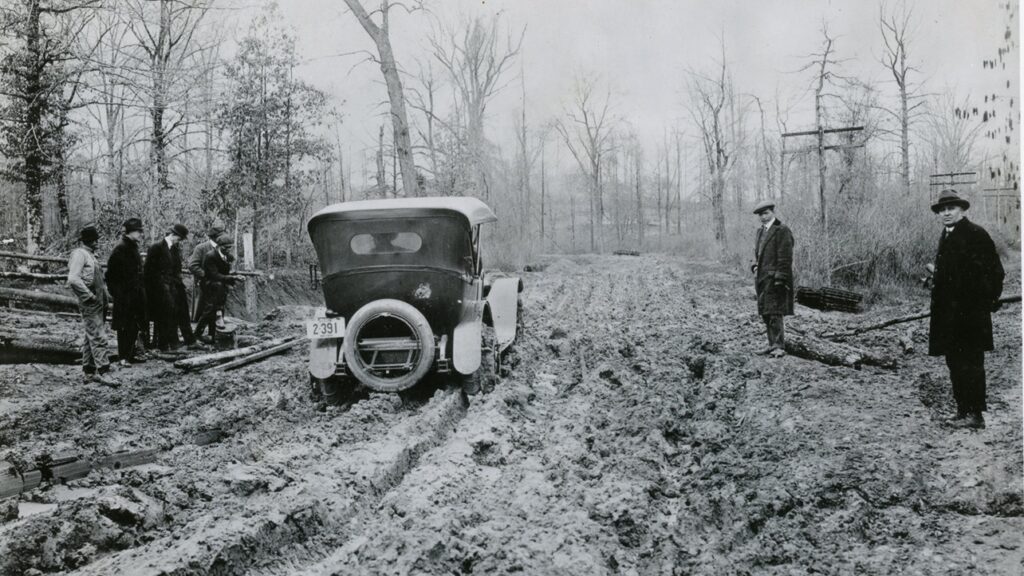
Feature Image (updated): Mud Road Near Quantico, Virginia, 1919