Virginia Economic Development Week recently brought a burst of energy and optimism from the Virginia Economic Developers Association. Their message was clear and emphatic: “Economic Development is the ANSWER. To Better Housing. To Stronger Education. To Workforce Opportunities. To Sound Transportation Networks. To Better Healthcare.”
It is hard not to appreciate the spirit behind this message. Economic development professionals across Virginia work tirelessly to strengthen local economies, attract employers, support entrepreneurship, revitalize communities, and create opportunities for residents. And in turn, economic development generates the tax dollars needed to fund education, public infrastructure, healthcare, and other public services.
Virginia has long benefited from a strong culture of state-local cooperation around economic development, and organizations like VEDA play an important role in sustaining that culture. At the same time, however, I found myself reflecting on the reverse side of the equation.
The reverse is also true: education is the answer
While economic development may indeed be the answer to many of our public challenges, the reverse is also true. Stronger education is also the answer to economic development. Better transportation systems are the answer to economic development. Investments in public infrastructure, public safety, parks, housing, higher education, and community institutions are all central ingredients of long-term economic success.
In fact, one could argue that the most successful communities rarely emerge because they simply pursued “economic development” in the narrow sense. Rather, they succeed because they became places where people and businesses genuinely wanted to live, work, invest, and raise families. That distinction matters.
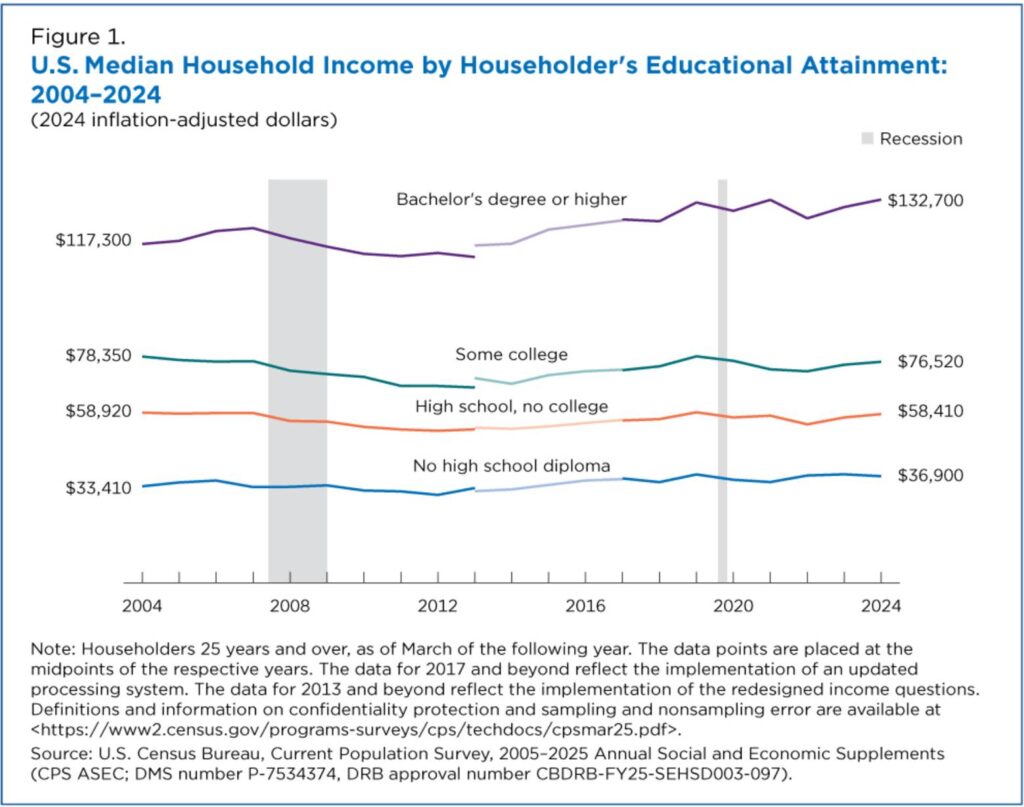
The number one determinant of a household’s economic success is the level of education. So, if Virginia’s communities—and together, as a commonwealth—are serious about economic development, we should become serious about education. First, each local government should be serious about providing the best public education it can. Second, every locality should pursue serious efforts to attract and retain a productive and educated labor force. And third, collective, we should make sure Virginia has not only high-quality higher education, but affordable higher education. Because in the end, a locality with an education population is the foundation for an economically and fiscally successful locality.
Economic development does not occur in a vacuum
Too often, economic development discussions implicitly treat public investment and economic growth as though they are separate—or even competing—concepts. In reality, they are deeply intertwined.
Businesses are attracted to skilled workers, but skilled workers depend on strong educational systems. Employers value transportation access and infrastructure reliability, but these require sustained public investment. Companies seek stable and attractive communities, yet those communities are themselves the product of long-term investments in governance capacity, public services, housing, amenities, and quality of life.
Northern Virginia’s economic success did not happen solely because firms decided one day to relocate here. It emerged over decades through a combination of federal investment, transportation infrastructure, strong public schools, higher education institutions, research capacity, and local governments capable of managing rapid growth. The same can be said, in different ways, for other successful regions across the Commonwealth—from the port and logistics infrastructure of Hampton Roads to university-centered innovation ecosystems in Charlottesville and Blacksburg.
Even many rural economic development success stories ultimately rest on investments in broadband connectivity, workforce development, industrial sites, public universities, community colleges, water and sewer systems, and transportation access. None of these efforts are secondary to economic development: these investments are economic development.
Communities cannot simply market themselves into prosperity
There is also a broader lesson here for local governance. Communities often speak enthusiastically about attracting jobs, investment, and economic opportunity, but become far more hesitant when discussions turn to the investments necessary to sustain competitiveness over the long term.
Residents may demand affordability while opposing new housing. They may demand lower congestion while resisting transportation investments or land-use changes. They may want high-performing schools, attractive parks, responsive emergency services, and effective public administration while simultaneously opposing the taxes or staffing structures required to support those systems.
This tension is hardly unique to Virginia. In many ways, it reflects a broader challenge in American public life and American federalism. We often celebrate the outcomes associated with prosperous and well-functioning communities while underestimating the institutional and fiscal foundations required to produce them.
In practice, successful economic development is rarely about a single incentive package or recruitment effort. It is much more often the cumulative product of decades of investment and governance decisions—and constructive collaboration between the public sector, the local business community, and citizens—that make communities resilient, functional, and attractive over time.
The overlooked role of local government
One of the more interesting aspects of economic development debates is how often local government itself disappears from the conversation, even though local governments are among the primary architects of economic competitiveness.
School systems develop human capital. Planning and zoning shape housing supply and commercial development patterns. Public transit and transportation choices maintain mobility. Public safety agencies provide stability. Utilities ensure reliability. Parks and libraries contribute to quality of life. Community colleges and workforce programs support labor market readiness. In this sense, economic development is not simply the work of economic development offices. It is the product of an entire ecosystem of public institutions and community investments.
This is one reason why simplistic anti-government narratives—government inefficient and bad, cutting taxes good—often fail to align with the realities of regional economic success. The most economically dynamic regions in the United States generally do not have low taxes and weak public sectors. Rather, they tend to have capable public institutions that are able to support growth, manage complexity, and sustain quality of life alongside private-sector dynamism.
Indeed, many local governments today operate organizations of extraordinary scale and complexity. Fairfax County alone delivers dozens of major public services and oversees a workforce larger than many Fortune 500 companies. The quality of public administration matters enormously to whether communities function effectively and remain economically competitive.
A stronger Virginia requires committed communities and a stronger for local government
Ultimately, the VEDA message gets something fundamentally right. Stronger connections do help build stronger communities and a stronger Virginia. But the relationship works in both directions.
Economic growth helps communities generate the revenues needed to invest in schools, infrastructure, and services. At the same time, communities that are willing to invest seriously in education, transportation, governance capacity, housing, and public infrastructure are often the very communities best positioned to generate sustainable economic growth in the first place. The strongest economies are rarely built through marketing alone. They are built through long-term investments in people, institutions, and places.
Economic development is indeed part of the answer. But strong communities—willing to invest in themselves and in their collective future—are part of the answer too.